
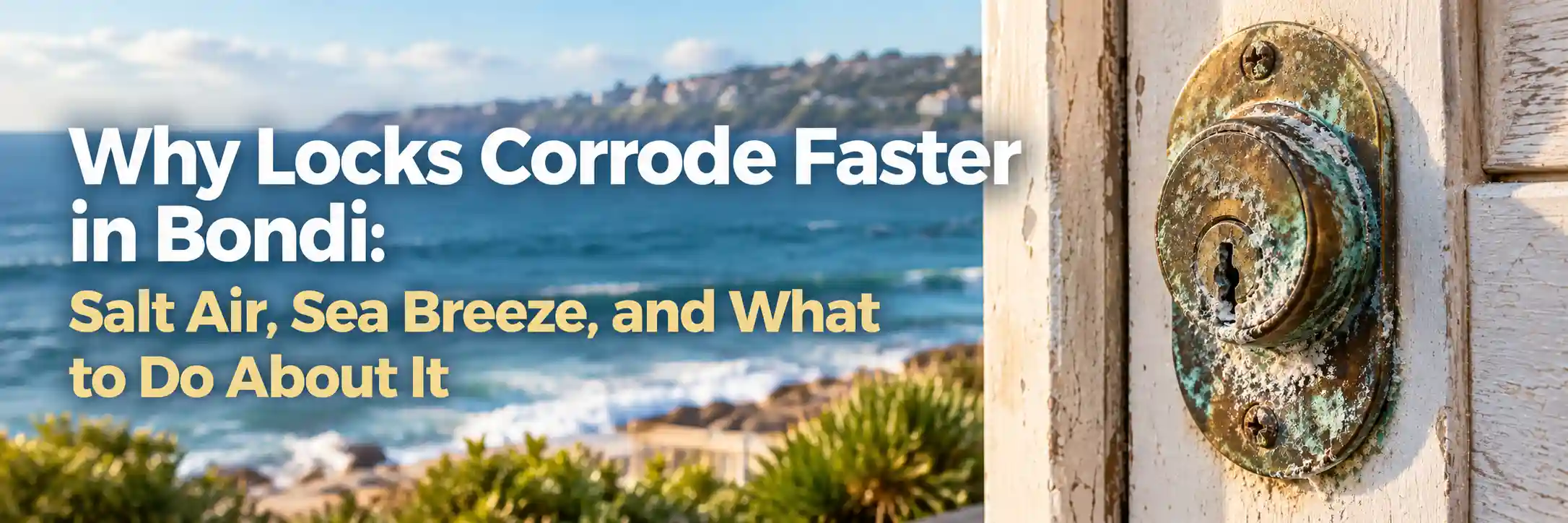
Nobody warns you about this when you move to Bondi. The apartment is perfect, the ocean view is everything you hoped for, and then eighteen months later you’re jiggling your front door key in the dark, wondering why the lock that worked fine last winter now feels like it’s full of wet sand. It is, in a way. Lock corrosion Bondi salt air causes is one of the most consistent and least-discussed maintenance issues for properties within a few kilometres of the beach — and it gets worse the closer you are to the water.
The problem isn’t unique to Bondi, but Bondi’s combination of ocean exposure, afternoon sea breezes pushing salt-laden air directly into the eastern suburbs, and a housing stock dominated by apartments where external hardware gets no protection from eaves or covered entries makes it particularly acute here.
What Salt Air Actually Does to a Lock
The process is electrochemical rather than just physical. Salt in the air — sodium chloride — dissolves in humidity and forms a mildly conductive solution on metal surfaces.
This solution accelerates the oxidation process dramatically. Steel corrodes, brass tarnishes and eventually pits, zinc-alloy components (common in cheaper lock internals) degrade from the outside in.
Inside a lock cylinder, the effect compounds. The spring-loaded pins that the key lifts to the correct height are precision steel components.
They’re housed in the cylinder body and protected somewhat from direct salt exposure — but not completely. Moisture wicks in through the keyway, deposits salt, and over months or years the pins develop microscopic corrosion that changes how they move. Smooth operation becomes sticky operation. Sticky becomes stiff. Stiff becomes the lock that won’t turn on a wet Tuesday morning.
The strike plate on your door frame is often worse. Unlike the cylinder, which at least has some moving parts to distribute lubricant, the strike plate sits stationary, exposed to whatever weather comes through the corridor or hits the external wall. Strike plates on Bondi properties within half a kilometre of the beach can show significant surface corrosion within two years of installation if they’re not stainless or marine-grade.
The Corrosion Gradient: How Distance from the Beach Changes Everything
Not all Bondi properties face the same salt exposure. There’s a rough gradient based on distance and orientation that’s worth understanding if you’re trying to decide how seriously to take the maintenance question.
Properties directly on Campbell Parade and the streets immediately behind it — within three or four blocks of the beach — face the harshest conditions. The afternoon sea breeze that rolls in off the Pacific carries aerosol salt at concentrations that are genuinely damaging to unprotected metal hardware.
In these locations, cheap builder-grade hardware that might last fifteen years in Parramatta will show significant deterioration in three to five years.
Further back — the streets around Bondi Road, up toward Bondi Junction — the salt concentration drops, but it doesn’t disappear. Properties in this zone see accelerated hardware degradation compared to inland Sydney, but at a more manageable rate. Standard maintenance practices go a longer way here than they do oceanfront.
Orientation matters too. A north or west-facing entry door that doesn’t directly face the incoming afternoon sea breeze is meaningfully more sheltered than an east or south-east facing entry. If your building has a covered entry or the door sits in a recessed threshold, that physical protection makes a real difference to how quickly the hardware ages.
Pro Tip:
Buy a small tube of marine-grade PTFE or silicone lock lubricant and keep it with your other household maintenance items. Four times a year — roughly with the seasons — spray a small amount into the keyway and work the key in and out a few times. This simple routine costs about ten minutes per year and dramatically extends cylinder life in a coastal environment. Standard WD-40 isn’t the right product: it’s a moisture displacer, not a lubricant, and it attracts fine particles that accelerate wear rather than preventing it.
Spotting Corrosion Before It Becomes a Lockout
The frustrating thing about coastal lock corrosion is that it’s largely invisible until it’s already causing problems. The cylinder looks fine from the outside. The external hardware may have some tarnish but still appears functional. The failure is happening in the mechanism, not on the surface.
These are the early signals worth paying attention to:
- The key requires more force than it used to — not a specific technique, just noticeably more resistance on the turn
- The key feels rough or gritty during insertion, rather than smooth
- The deadbolt throw is slower or requires the door to be in a specific position to engage cleanly
- Visible white or green powdery deposits around the keyhole or on the external hardware
- The cylinder has become sensitive to humidity — works fine on dry days, stiff on wet or very humid days
- Any exterior hardware showing active rust, significant pitting, or deep tarnish
The humidity-sensitivity pattern is particularly telling. A cylinder that’s fine when it’s dry but struggles when the air is heavy with moisture has already developed enough internal corrosion that humidity is affecting pin movement. At that stage, cleaning and lubrication may buy another season or two, but the cylinder is on borrowed time.
Hardware That Actually Survives the Bondi Environment
Not all lock hardware responds the same way to salt air. The choice of material and grade at the time of installation makes a significant difference to how long the hardware performs reliably.
Stainless steel is the benchmark for coastal environments. Grade 316 stainless — sometimes called marine-grade stainless — has the chromium and molybdenum composition that genuinely resists salt corrosion rather than just delaying it.
It’s more expensive than standard hardware, substantially so in some cases, but for a property within a kilometre of the beach it’s the specification that makes long-term financial sense. The cost difference between standard and marine-grade hardware, spread over the longer service life, usually favours marine-grade.
Solid brass performs well in coastal environments when it’s genuine solid brass rather than a brass-plated zinc alloy. Brass tarnishes in salt air — the familiar greenish patina is natural and doesn’t indicate the hardware is failing — but underneath that patina, solid brass remains structurally sound.
Many of Bondi’s older properties have original solid brass hardware that’s outlasted several rounds of cheaper replacements.
Zinc alloy and pot metal are common in builder-grade hardware and perform poorly near the coast. The material looks similar to brass or steel at installation but corrodes differently — rather than surface oxidation, it tends to pit and swell, eventually causing the housing itself to deform. Swollen housing is what causes cylinders to seize completely rather than just becoming stiff.
The Strata Question: Who’s Responsible for Common Area Hardware?
For Bondi’s apartment residents — the majority of people living within a kilometre of the beach — the corrosion question gets more complicated when it involves common property. The intercom panel in the lobby, the gate latch on the car park entrance, the hardware on the building’s external doors: all of this is strata-managed and strata-funded.
What individual unit owners can do within their own lot — replace the unit entry cylinder with a marine-grade equivalent, maintain their own hardware — is entirely within their control. What happens to the building’s common property hardware is the owners corporation’s responsibility to fund and manage. This doesn’t mean you can’t raise it.
If the common entry hardware in your Bondi building is visibly corroding, deteriorating, or causing access problems — a corroded intercom panel, a lobby door latch that sticks in wet weather — this is worth raising formally with the strata manager. A written request, noted in the AGM agenda if needed, creates a record and usually accelerates action. Strata committees in Bondi buildings with high owner-occupier ratios tend to respond more quickly than those dominated by distant investors.
Maintenance vs Replacement: Making the Call
Not every corroded lock needs replacing. The right call depends on where the corrosion is and how far it’s progressed.
Cleaning and lubrication is appropriate for early-stage corrosion where the mechanism still operates, just with more effort than it should. A professional clean and re-lubrication with appropriate products can restore smooth operation and buy meaningful additional service life. This is the right response to the first signs of salt-related stiffness.
Cylinder replacement makes sense when the mechanism has progressed beyond what maintenance can address — the humidity-sensitivity pattern described above, visible pitting on the cylinder face, or a mechanism that’s clearly operating below its original precision. Replacing the cylinder while keeping the external hardware (if the hardware is solid brass or stainless and still in good condition) is usually the most cost-effective approach.
Full hardware replacement is warranted when the external components — the deadbolt case, the external escutcheon, the strike plate — are showing corrosion that goes beyond cosmetic. Pitting and swelling in the hardware body means the structural integrity is compromised, not just the appearance. This is also the right moment to upgrade to marine-grade specification if the current hardware is builder-grade.
Warning:
Don’t delay a lock replacement in a Bondi property just because the key still technically works. A cylinder in the late stages of salt corrosion doesn’t fail gradually — it tends to fail suddenly, often when humidity is high, which usually means at the worst possible moment.
A lock that’s been stiff for six months and is getting stiffer is giving you clear advance warning. Act on it before it becomes a 3am locksmith callout.
A Sensible Maintenance Schedule for Bondi Properties
This isn’t complicated, but it does need to be deliberate rather than reactive:
- Quarterly lubrication — PTFE or silicone spray into the keyway, light oil on external pivot points. Set a calendar reminder.
- Annual inspection — check all external hardware for signs of pitting, white deposits, or swelling. Run every key in every lock and note any that require more effort than usual.
- After major weather events — a winter storm with heavy salt spray deserves a wipe-down of exposed hardware and a lubrication pass.
- At any change of occupancy — whether buying, renting, or welcoming an Airbnb guest, the key transition is a natural moment to check hardware condition.
Conclusion
Living in Bondi means accepting that some things wear faster than they do inland — and locks are firmly on that list. Lock corrosion Bondi salt air causes isn’t a reason to panic, but it is a reason to think about hardware specification and maintenance in a way that most Sydney homeowners don’t need to.
Marine-grade hardware where it matters, regular lubrication, and attention to the early warning signs of corrosion — that combination keeps a Bondi property’s security hardware reliable through the conditions that the beach lifestyle brings with it. The alternative is discovering the problem when it’s become a lockout rather than a maintenance task.